

Introduction
Charitable trusts, registered societies, and Section 8 companies play an important role in India’s social development. To manage their activities effectively, eligible nonprofit organizations should understand the tax-registration requirements that apply to their structure, activities, and funding plans.
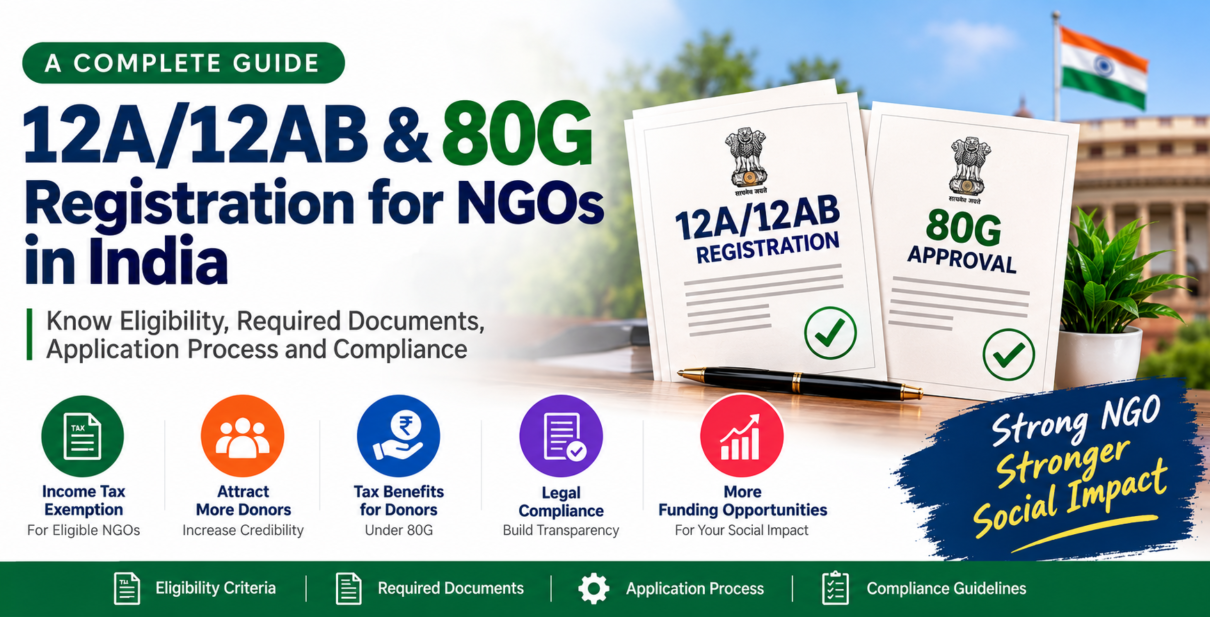
12A/12AB registration and 80G approval are commonly used terms in the NGO sector. They relate to two different benefits: tax treatment of eligible charitable organizations and potential tax deductions for eligible donors.
India’s income-tax framework changed from April 2026. Therefore, NGOs applying now must check the applicable provisions and forms under the Income-tax Act, 2025, rather than automatically relying on older Form 10A and Form 10AB instructions. The Income Tax Department’s current guidance identifies Forms 104 and 105 for relevant nonprofit registration and approval procedures.
Income Tax Department
+1
1. What Is 12A/12AB Registration?
Under the earlier Income-tax Act, 1961, Sections 12A and 12AB formed the framework for registration of eligible charitable or religious trusts and institutions seeking income-tax exemption on qualifying income, subject to applicable conditions.
Organizations commonly seeking this registration include:
– Public charitable trusts
– Registered societies working for charitable purposes
– Section 8 nonprofit companies
– Eligible educational and healthcare institutions
– Organizations engaged in other qualifying charitable activities
Registration does not mean that all income is automatically tax-exempt. The organization must satisfy the applicable conditions regarding its objectives, activities, income, expenditure, and reporting.
2. What Is 80G Approval?
Under the earlier Income-tax Act, 1961, Section 80G provided a framework under which eligible donors could claim deductions for qualifying donations made to approved organizations, subject to applicable rules.
For an eligible NGO, 80G approval can help make its fundraising appeals more attractive to potential donors.
Potential benefits include:
– Increased awareness among individual donors
– Better preparation for corporate and philanthropic outreach
– Greater clarity about donation-related tax benefits
– Improved fundraising documentation
– Support for long-term donor relationships
Important: An NGO must not advertise that every donation qualifies for a tax deduction. Eligibility depends on the organization’s approval status, the donor’s circumstances, the nature of the donation, and applicable tax rules.
3. Difference Between 12A/12AB and 80G
Particulars 12A/12AB framework 80G framework
Main purpose Tax treatment of eligible NGO income Potential tax deduction for eligible donors
Primary beneficiary Eligible charitable organization Eligible donor
Typical requirement Registration and continued compliance Separate donor-related approval and compliance
Automatic benefit? No; conditions apply No; qualifying conditions apply
These are the familiar terms under the previous tax framework. For applications made in the current tax year, confirm the corresponding provisions under the Income-tax Act, 2025.
4. Eligibility Requirements for NGOs
Eligibility depends on the legal structure, charitable objectives, activities, and applicable statutory provisions.
An organization should generally review the following before applying:
– Whether it is legally established in India.
– Whether its governing documents specify its objectives and activities.
– Whether those objectives qualify under the applicable nonprofit provisions.
– Whether its actual activities are consistent with its stated objectives.
– Whether its accounts and financial records are properly maintained.
– Whether it meets the applicable registration and approval conditions.
– Whether it can provide accurate information and supporting documents.
An NGO’s registration as a trust, society, or Section 8 company does not, by itself, establish eligibility for every tax benefit.